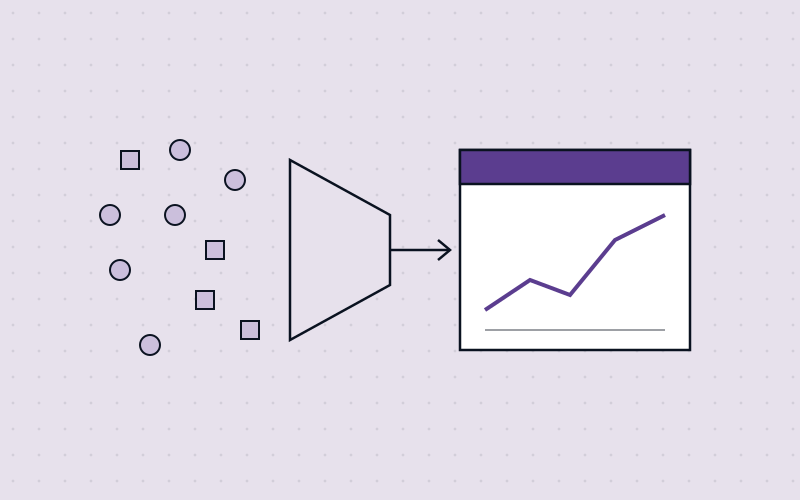

Many organizations already have the raw material for a valuable data product.
It may be quality inspection history, microscopy images, clinical workflow records, customer reports, field notes, research observations, project delivery data, sales conversations, or years of expert judgment stored across spreadsheets and documents. The problem is not always that the data is missing. The problem is that it is not packaged into something customers, funders, partners, or internal decision makers can use.
This is where customer-facing intelligence products become important.
A customer-facing intelligence product is not just a dashboard. It is a usable layer around data, analysis, workflow, and domain expertise that helps someone outside the delivery team make a better decision, understand value faster, or see evidence that was previously hidden. It can be a portal, report, analytics workflow, AI-assisted review system, quality evidence layer, funder dashboard, or premium service line.
For many expert teams, this is a more practical starting point than asking, “How can we use AI?” A better question is:
What valuable evidence do we already create, and who would act differently if they could see it clearly?
Start with the customer decision
The first mistake is starting with a dashboard layout, model architecture, or data warehouse plan.
Useful customer-facing intelligence products start with a decision or proof point. Examples include:
- A manufacturer wants customers to see quality trends, inspection evidence, and recurring defect patterns.
- A life-sciences company wants partners to understand experiment results, cell quality, or screening progress more quickly.
- A civic organization wants funders to see incident evidence, program outcomes, and monitoring signals in one place.
- A healthcare workflow company wants clinics or partners to see referral, intake, triage, or service-performance patterns.
- A consulting or expert services firm wants clients to see live evidence behind recommendations instead of waiting for static reports.
In each case, the product is not valuable because it contains data. It is valuable because it changes a customer, funder, or partner conversation.
A strong starting sentence is:
If this intelligence product works, our customer will be able to decide, trust, renew, expand, report, or act faster because ____.
Without that sentence, the team may build an attractive interface that nobody uses.
What makes data productizable?
Not every dataset is ready to become a product. The best candidates usually have five traits.
First, the data is tied to a recurring question. If customers, funders, operators, or partners ask the same question repeatedly, there may be a product opportunity.
Second, the data has context. Raw numbers are rarely enough. Useful intelligence products include definitions, process notes, quality checks, source context, review status, and the domain knowledge needed to interpret the data.
Third, the data can support action. A customer-facing product should make it easier to choose a next step, not only admire a chart.
Fourth, the organization can maintain it. A product that works once but cannot be updated, governed, or explained will lose trust quickly.
Fifth, the product creates visible value. That value may be premium revenue, better retention, stronger reporting, faster sales demos, better customer success, fewer quality disputes, or stronger funder evidence.
IBM describes data products as reusable, curated data assets designed around usability, ownership, quality, and business value. That framing is useful because it shifts the conversation from “we have data” to “we have a product someone can rely on.”
Package expertise, not just records
Expert organizations often underestimate the value of the interpretation layer around their data.
A manufacturer may have thousands of images, but the valuable part is not only the images. It is the inspection logic, defect categories, process context, customer requirements, and quality-team judgment.
A research organization may have field reports, but the valuable part is the evidence structure, source review, geographic context, and implications for policy or funding.
A clinical workflow company may have intake and referral data, but the valuable part is the care-navigation logic, service constraints, escalation rules, and operational feedback.
A customer-facing intelligence product should make that expertise visible. Otherwise, it becomes a thin reporting surface. The product should answer questions such as:
- What does this signal mean?
- How reliable is it?
- What changed since the last review?
- Which cases require attention?
- What evidence supports this recommendation?
- What action should the customer or partner consider next?
This is also where AI can help, but AI should be added to the workflow after the product question is clear. AI may summarize evidence, classify images, flag anomalies, prioritize cases, extract fields, or support review. It should not replace the need to define the decision, user, evidence standard, and operating model.
Design the operating model before the interface
Customer-facing intelligence products create trust only when someone owns the system behind the screen.
Before building, teams should decide:
- Who owns each data source?
- How is data cleaned, reviewed, and updated?
- What is visible to customers versus internal users?
- What outputs require human review?
- How are errors corrected?
- What happens when the system is uncertain?
- What access controls, audit trails, and privacy rules are needed?
- How will users know whether the data is current?
Data mesh thinking is useful here because it emphasizes data ownership, data as a product, self-serve infrastructure, and governance. Even if a small company does not need a formal data mesh, the principle still matters: a useful intelligence product needs ownership, quality standards, documentation, and governance.
The same applies when machine learning is involved. MLOps practices exist because deployed models need monitoring, retraining, versioning, and operational management. For a first customer-facing product, the implementation can be lightweight, but it cannot be careless.
Build the narrowest useful version
The first version should be narrow enough to ship, but useful enough to change a real conversation.
Instead of “build a customer portal for all analytics,” choose one focused workflow:
- a quality evidence dashboard for one product line
- a funder reporting view for one program
- an experiment review workspace for one assay or study type
- a client-facing performance layer for one service offering
- a referral or intake intelligence view for one clinical workflow
- a sales or customer-success intelligence layer for one high-value segment
A narrow first version helps the team learn quickly:
- Do customers understand the output?
- Do they trust the evidence?
- Does it shorten review or reporting cycles?
- Does it support a renewal, proposal, upsell, or decision?
- Which data quality issues matter in practice?
- Which features are unnecessary?
The goal is not to prove that every data product idea is possible. The goal is to prove that one intelligence layer creates enough value to justify the next investment.
Measure adoption and value
A customer-facing intelligence product should be measured differently from an internal dashboard.
Useful metrics include:
- active customer or partner usage
- repeat visits before meetings, renewals, reports, or decisions
- time saved preparing customer or funder evidence
- number of customer questions answered without manual back-and-forth
- premium revenue, upsell, renewal, or retention influenced
- sales-cycle support from demos or proof-of-value artifacts
- reduction in reporting delays or quality disputes
- user trust, comments, and requested improvements
The value does not need to be purely financial at first. Stronger reporting, clearer evidence, and faster decisions can all be legitimate early signals. But the team should still connect the product to an outcome that matters.
If the product is meant to support revenue, measure whether it helps sell, renew, expand, or differentiate. If it is meant to support operations, measure whether it reduces delays, rework, or investigation time. If it is meant to support funders or partners, measure whether it improves reporting quality, transparency, and decision confidence.
Manage risk as part of the product
When an intelligence product faces customers, risk management is not optional.
The product may expose sensitive information, influence decisions, summarize uncertain evidence, or create expectations customers will rely on. NIST’s AI Risk Management Framework emphasizes governance, mapping, measurement, and management of AI risks across the system lifecycle. For practical teams, that means asking:
- What should never be shown externally?
- Which outputs need explanation or review?
- How will users know the limits of the system?
- What data is sensitive, regulated, confidential, or customer-specific?
- Who can correct or challenge an output?
- What logs or audit trails are needed?
- What monitoring will show quality drift or outdated data?
Trust is part of the product experience. A simple product that is clear, current, and governed is often more valuable than a broad product that customers do not trust.
A first-sprint checklist
Before investing in a full customer-facing intelligence product, expert teams can run a focused sprint around one use case.
A practical checklist:
- Customer decision: What decision, report, renewal, proposal, or workflow should improve?
- User: Who will use the product, and when?
- Existing data: What data, documents, images, records, reports, or expert review already exist?
- Interpretation layer: What domain knowledge makes the data useful?
- Evidence standard: What must be reviewed, explained, or validated?
- Narrow product: What is the smallest useful intelligence layer?
- Operating model: Who owns updates, access, corrections, and monitoring?
- Value metric: How will the team know whether the product changes behavior or creates value?
- Risk controls: What should be private, governed, audited, or human-reviewed?
- Next investment decision: Stop, iterate, expand, or productize further.
This keeps the project grounded. The aim is not to turn every dataset into a platform. The aim is to identify one high-value place where data and expertise can become a product customers can actually use.
For many organizations, that is the real opportunity in AI and data work: not only automating internal tasks, but making expertise visible, useful, and valuable at the moment customers need it.
If your team already has operational, research, clinical, quality, civic, or customer data and wants to identify one customer-facing intelligence product worth building first, ModAstera can help scope a focused deployed-intelligence sprint.