
AI ROI is often discussed too late.
A team builds a promising model, dashboard, agent, or workflow prototype. The demo works. The accuracy looks acceptable. Leadership asks what the return will be. Then the project has to justify itself after the technical path has already shaped the business case.
That order is backwards.
For most expert teams, AI ROI should be defined before the pilot starts. The important question is not only “can this model work?” It is “what decision, revenue opportunity, quality improvement, reporting obligation, or customer experience will change if this system is deployed and used?”
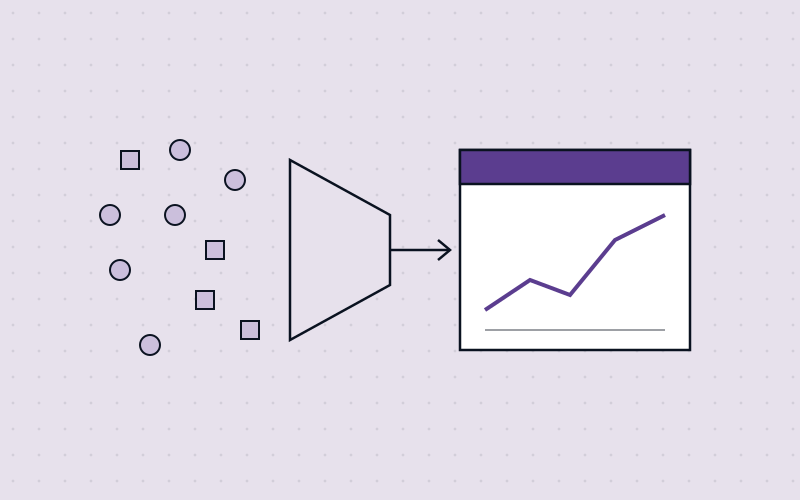
That distinction matters because prototypes can create excitement without creating value. Deployed intelligence, by contrast, is a working system that helps people make better decisions, launch new services, improve operations, or show customers and funders better evidence. Measuring ROI requires following the path from raw data to that deployed outcome.
Start with the business outcome, not the model
A useful AI ROI model begins with one sentence:
If this system works, it will improve ___ by ___ for ___ users or customers.
The blank should not be “AI adoption.” It should be something observable. Examples include:
- reducing time to investigate quality defects
- increasing completed consultations from existing demand
- helping a sales team prioritize higher-probability accounts
- turning internal research data into customer-facing analytics
- improving funder reporting with fresher, traceable evidence
- launching a paid intelligence layer around an existing service
This is where many AI initiatives become vague. They describe a technology, but not the economic or operating mechanism. “We will use AI on our data” is not an ROI case. “We will shorten root-cause analysis from five days to one day for our highest-volume quality issues” is much closer.
The value does not always come from labor savings. It may come from faster product launch, new revenue, higher conversion, better retention, fewer quality escapes, stronger proposals, better customer reporting, or avoided strategic mistakes. For ModAstera’s target customers, this value-add framing is often more useful than a narrow automation story.
Capture the baseline before the pilot
ROI needs a baseline. Without one, teams cannot tell whether the AI system changed the outcome or simply looked impressive in isolation.
Before building, define the current state:
- How long does the workflow take today?
- How many cases, images, reports, leads, referrals, or decisions move through it each month?
- What errors, delays, missed opportunities, rework, or manual bottlenecks occur?
- Which users are responsible for acting on the output?
- What is the commercial, operational, clinical, quality, or reporting consequence of improvement?
The baseline does not need to be perfect. A practical range is often enough for a first sprint. For example, a manufacturer may estimate the cost of repeated inspection review, delayed root-cause analysis, and customer reporting effort. A life-sciences service company may estimate the value of faster experiment review, stronger customer evidence, or one additional retained contract. A civic organization may estimate the value of better grant reporting or a stronger evidence base for funders.
The goal is to connect the AI system to an outcome the organization already cares about.
Include the hidden cost of deployment
AI ROI is frequently overstated when teams count only model development cost. Production value usually depends on a wider system:
- data cleaning and structuring
- integrations with existing tools
- workflow design
- user review and exception handling
- monitoring and retraining
- security and access control
- governance and documentation
- change management and adoption
MLOps exists because machine learning systems do not end at training. IBM describes MLOps as practices for building and running models across development, deployment, monitoring, retraining, and governance. Martin Fowler’s CD4ML article makes a similar point: machine learning delivery changes across code, data, and models, so reproducibility and release discipline matter.
This does not mean every first project needs a heavy enterprise platform. It means ROI should include the operating work required to keep the system useful after the demo. A lightweight deployed-intelligence sprint can still be disciplined: define the workflow, version the data assumptions, test with users, document failure modes, and choose the few metrics that matter.
Measure value at three levels
AI ROI becomes clearer when measured at three levels.
1. Technical performance
This includes accuracy, recall, precision, latency, coverage, data quality, uptime, and model drift. These metrics are necessary, but they are not sufficient. A model can perform well technically and still fail if users do not trust it, if it does not fit the workflow, or if it improves a metric that nobody values.
2. Workflow performance
This is where deployed intelligence starts to show value. Workflow metrics include cycle time, review time, number of cases processed, exception rate, handoff delays, user adoption, and the percentage of outputs that lead to action.
For example, a quality inspection model should not be judged only by image classification accuracy. It should also be judged by whether quality teams can investigate issues faster, produce clearer reports, and prioritize the defects that matter.
3. Business value
Business metrics connect the system to money, risk, or strategic value. Depending on the organization, these may include revenue influenced, contracts won, churn avoided, downtime reduced, rework reduced, grants supported, consultations completed, premium-service revenue, or faster product launch.
This is the level leadership ultimately cares about. The mistake is trying to jump directly to business value without measuring the technical and workflow layers that explain why value is or is not appearing.
Use a simple ROI equation, then improve it
A first-pass AI ROI model can be simple:
ROI = estimated value created or protected minus total cost of building and operating the system.
The value side may include:
- new revenue or upsell enabled
- earlier launch value
- improved conversion
- avoided rework, downtime, or quality cost
- retained customers or funders
- better decision outcomes
- avoided manual work where appropriate
The cost side should include:
- discovery and data assessment
- data preparation
- implementation
- integration
- deployment
- user testing
- monitoring
- maintenance
- internal time from domain experts
The equation will be approximate at first. That is acceptable. The important discipline is to make assumptions explicit and review them after the system is used.
Tie risk management to ROI
Risk is not separate from ROI. If a system creates compliance, safety, trust, privacy, or reliability problems, the apparent return can disappear.
NIST’s AI Risk Management Framework emphasizes mapping, measuring, managing, and governing AI risks across the design, development, use, and evaluation of AI systems. For practical teams, that means the ROI plan should include basic risk questions:
- What decisions will this system influence?
- What happens if it is wrong?
- Who reviews uncertain outputs?
- What data should not be captured or exposed?
- Which users need explanation, audit trails, or override controls?
- What monitoring will show that the system is degrading?
This is especially important in healthcare, manufacturing, civic, and research workflows. Validation and governance are not paperwork added after value is proven. They are part of what makes value durable.
A practical first-sprint scorecard
For a focused deployed-intelligence sprint, a useful scorecard might include:
- Target outcome: the decision, workflow, or revenue path the system should improve
- Baseline: current volume, time, error, cost, or opportunity level
- Data readiness: what data exists, what is missing, what must be cleaned
- Prototype evidence: early technical performance and user feedback
- Workflow evidence: whether users can act on the output
- Business evidence: estimated value created, protected, or accelerated
- Operating cost: integration, monitoring, review, and maintenance needs
- Risk controls: validation, access, audit, privacy, and escalation plan
- Next decision: stop, iterate, deploy narrowly, or expand
This scorecard keeps teams from treating a pilot as a yes-or-no technology experiment. It turns the pilot into a decision system for investment.
How expert teams should think about the first use case
The best first AI ROI case is rarely the flashiest one. It is usually a workflow where four things are true:
- The data is messy but valuable.
- A real business or operating decision is already waiting.
- Domain experts can review outputs quickly.
- A working system would be useful even before it is perfect.
That is why expert organizations are often strong candidates. They already have domain knowledge, customers, evidence, reports, images, workflows, and operating history. The opportunity is to convert those assets into deployed intelligence before the revenue, reporting, funding, quality, or customer window passes.
A good AI ROI question is therefore not “how much AI can we add?” It is:
Which high-value workflow could become a working intelligence system in the next 4 to 6 weeks, and how would we know it created value?
If the answer is clear, the team has the beginning of a practical AI ROI case.