Digital pathology archives can contain years of potentially useful evidence. Yet finding the right prior case may still depend on report wording, folder structure, remembered diagnoses, or a colleague who knows where to look.
That creates a practical gap. A researcher may have a region of interest and want to find morphologically related cases. A translational team may need to construct a retrospective cohort. A pathologist may want comparison material for consultation, education, or quality review. Text search helps when the right terms already exist, but morphology does not always fit neatly into a report field.
Pathology image retrieval offers another route. It uses the visual content of a query region or whole-slide image to rank related material in an authorized archive. Modern pathology models can represent image regions as numerical embeddings, which makes large-scale similarity search increasingly practical.
But a nearest-neighbor list is not yet a trustworthy workflow. The useful system is the evidence path around the ranking: the question being asked, the searchable collection, source context, human review, exclusions, uncertainty, and the record of how retrieved candidates became a cohort.
What pathology image retrieval actually does
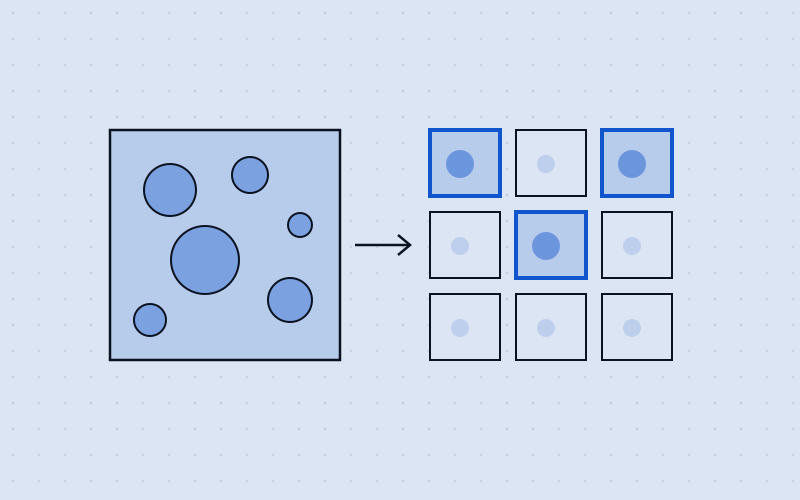
A retrieval workflow usually begins with an image region, patch, or slide. A model converts that input into a numerical representation. The system compares it with representations from an indexed collection and returns the closest candidates according to a chosen similarity measure.
Older content-based image retrieval systems relied on hand-designed descriptors for color, texture, shape, and spatial pattern. Research in digitized histopathology showed why this can complement text search: visual content may contain distinctions that are difficult to capture with report terms alone.
Today, self-supervised and visual-language foundation models can produce reusable patch-level or slide-level representations. These models may support image-to-image search and, in some systems, text-to-image or image-to-text retrieval. That broadens what can be searched, but it does not remove the need to define the task.
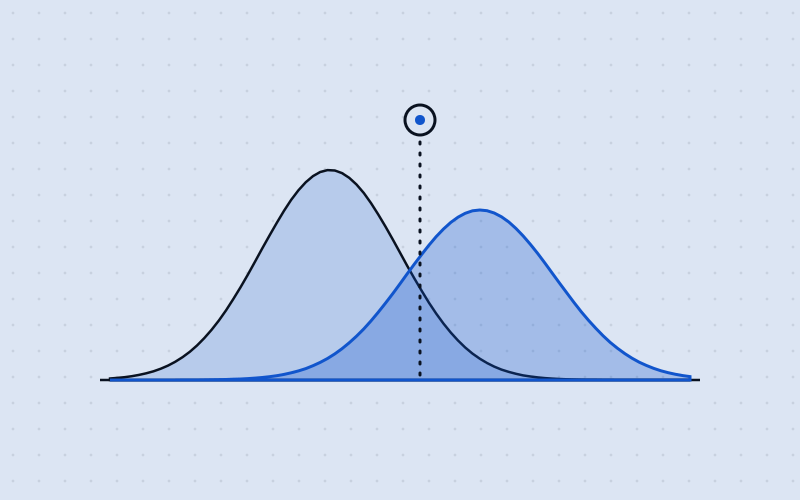
The returned distance means only that two items are close under a particular model, preprocessing pipeline, index, and query. It does not prove that they share a diagnosis, molecular state, prognosis, or treatment response.
Start with a question, not an encoder
The most important pilot decision is not which foundation model to use. It is what the user is trying to retrieve.
A useful question might be:
- Which archived regions show morphology relevant to this research hypothesis?
- Which prior cases should a qualified reviewer consider for a retrospective cohort?
- Which slides contain patterns that warrant consultation or quality review?
- Which candidates should be screened for a study after applying approved metadata filters?
The question determines the relevant evidence, the query unit, the collection, the reviewers, and the success criteria. A retrieval system built around an undefined idea of similarity may look impressive while returning results that are irrelevant to the actual work.
Define the intended use carefully. Research cohort construction, education, quality assurance, and diagnostic assistance do not have the same risk or evidence requirements. If the workflow can affect patient care, specimen selection, or case exclusion, its validation and governance requirements become materially higher.
Control the searchable collection
Retrieval quality cannot exceed the integrity of the archive being searched.
Before indexing, teams should know which cases are authorized for the intended use, how patient and specimen identity is protected, and whether the archive has reliable tissue, stain, scanner, site, diagnosis, and study metadata. They should also define retention rules, access control, audit logging, and whether data can leave the source environment.
Duplicate control is especially important. Serial sections, repeated scans, adjacent patches, or multiple images from the same case can create deceptively strong results. A system may appear to retrieve highly relevant material when it is actually returning near-duplicates of the query.
For evaluation, split at the patient or case level as appropriate. Keep related specimens and regions together. Record data lineage so reviewers can distinguish a genuinely related case from another view of the same source.
Metadata filters also need care. Tissue, stain, specimen type, study, or site filters can make search more useful, but they can also leak the answer if the evaluation is meant to test morphology. State clearly which information was available to the search model, which was used only as a filter, and which remained hidden until review.
Choose the right query unit
Whole-slide images are gigapixel-scale. Searching them is not the same as comparing ordinary photographs.
A patch-to-patch workflow can retrieve local patterns, but a small field may omit architecture and case context. Patch-to-slide search can locate slides containing a related region, but aggregation rules influence the ranking. Slide-to-slide retrieval may better represent the case as a whole, yet compacting millions of pixels into one representation can hide rare but important areas.
There is no universally correct choice. The query unit should match the user question.
For a local morphological feature, preserve the query coordinates and magnification. For case-level search, document how patches were selected and aggregated. For every result, let the reviewer move from the ranked item back to the original slide and location.
Preprocessing matters too. Magnification, color normalization, tissue masking, tile size, artifact handling, and scanner variation can change the representation. These choices should be versioned with the model and index rather than treated as invisible plumbing.
Return context, not detached thumbnails
A ranked gallery is fast to scan, but isolated thumbnails can encourage overinterpretation.
Each candidate should preserve enough source context for a qualified reviewer to answer:
- Which case, specimen, slide, and region produced this result?
- What tissue, stain, scanner, and acquisition conditions apply?
- Is the region representative, or is it an artifact or incidental structure?
- Which model, preprocessing version, and index produced the rank?
- What metadata filters were active?
The reviewer should be able to open the source slide at the retrieved coordinates, inspect surrounding tissue, and compare at appropriate magnification. The interface should make technical failures, unavailable slides, and incomplete metadata visible.
This changes retrieval from a collection of plausible pictures into traceable evidence.
Keep reviewers in control
Human review is not a decorative approval step. It is part of the retrieval system.
Qualified reviewers should be able to mark a result relevant, not relevant, uncertain, duplicated, technically inadequate, or outside scope. They should be able to record a reason, save a candidate to a cohort, remove it later, and see who made each decision.
Uncertainty deserves a first-class state. Forcing every candidate into include or exclude can hide disagreement and create false confidence. Difficult items may require adjudication, a second reviewer, additional stains, or information that the retrieval system does not contain.
Review decisions can also improve future development, but feedback data needs governance. A relevance label reflects a particular question and reviewer context. It should not automatically become a diagnostic ground truth or be reused for another purpose without review.
Evaluate retrieval as a workflow
Retrieval should be evaluated against the question it is meant to support.
Model-centered measures can include precision among the top results, recall where a defensible reference set exists, ranking quality, and retrieval latency. These are useful, but they do not show whether the system helps a real user.
A practical pilot should also measure:
- Time to the first useful result
- Expert review time per query
- Cohort-construction time compared with the current method
- Relevant results among the top 5, 10, or 20
- Reviewer agreement and adjudication burden
- Duplicate and artifact rate
- Source-context completeness
- Search failure and abstention rate
- Correction burden and reasons for exclusion
Use the same representative queries when comparing candidate encoders or index settings. Keep the test collection fixed. Have expert reviewers assess results without being told which model produced them when practical.
Do not report only the best query. Include common failures, rare patterns, artifacts, staining variation, low-tissue regions, and cases from different scanners or sites. A retrieval system that succeeds on memorable examples but fails unpredictably in ordinary use is not ready for expansion.
Plan for domain shift and changing archives
Pathology representations can be sensitive to stain, preparation, scanner, compression, institution, population, and specimen differences. A model trained on broad public data may still behave differently on a local archive.
Local evaluation is therefore essential. Compare performance across the sources that matter to the intended use. Monitor the archive as new scanners, stains, sites, or specimen types are added. Version the index, because changing the collection can change rankings even when the query and model stay the same.
A useful system should also support rollback. If a new encoder or index reduces relevance for important queries, the team should be able to restore the previous version and reproduce earlier cohorts.
A practical pilot checklist
A bounded retrieval pilot can start with:
- One explicit research or review question
- One authorized archive with known lineage and rights
- One defined query unit, such as patch-to-slide
- One baseline, such as report search or manual folder review
- A fixed set of representative queries
- One or more named expert reviewers
- Predefined relevance and workflow metrics
- Source-linked results with inclusion, exclusion, and uncertainty states
- Failure examples and subgroup checks
- A go, narrow, or stop decision after evaluation
This scope is deliberately smaller than building a universal pathology search engine. The goal is to learn whether retrieval creates reliable value for one repeatable task before expanding the archive, model set, or clinical claims.
From similar images to reviewable evidence
Pathology image retrieval is becoming more feasible because reusable representations and efficient indexes can search visual archives without a new supervised model for every query.
The harder question is whether a team can trust and reproduce what happens after the search.
A credible workflow connects each ranked candidate to its source, keeps the expert in control, preserves uncertainty, measures real review outcomes, and treats similarity as a prompt for investigation rather than a diagnosis.
If your team is considering a retrieval pilot, start with one archive, one repeatable question, and one qualified reviewer. ModAstera can help scope the evidence, validation, and workflow layer needed to decide whether that pilot should stop, narrow, or move forward.
References
- Ochi M, Komura D, Ishikawa S. Pathology Foundation Models. JMA Journal. 2025;8(1):121-130.
- Qi X, et al. Content-based histopathology image retrieval using CometCloud. BMC Bioinformatics. 2014.
- Sparks R, Madabhushi A. Content-based image retrieval of digitized histopathology in boosted spectrally embedded spaces. Journal of Medical Imaging. 2015.
- Lu MY, et al. A visual-language foundation model for computational pathology. Nature Medicine. 2024.
- Kalra S, et al. Learning binary and sparse permutation-invariant representations for fast and memory efficient whole slide image search. Medical Image Analysis. 2023.
- DICOM Standards Committee. Supplement 145: Whole Slide Microscopic Image IOD and SOP Classes.
- NIST. AI Risk Management Framework.