A medical AI model has passed an offline evaluation. The next question is not simply whether to put its score on a clinician's screen. It is whether the surrounding system can receive the right inputs, produce an output at the right moment, and preserve enough evidence to explain what happened.
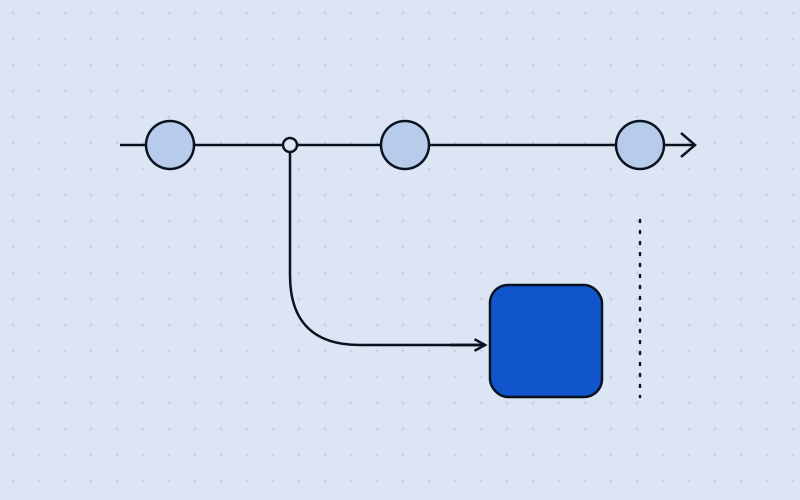
One way to investigate that gap is a prospective silent-mode evaluation: run the system alongside routine work, but keep its output from influencing care. The literature also calls this shadow-mode evaluation, distinguishing it from live evaluation in which the AI contributes to decisions that affect patients.[2]
The distinction is practical. A hidden score can help a team investigate data delivery and model behavior in its intended environment. It cannot, by itself, demonstrate that clinicians make better decisions after seeing that score. Those are different questions and should have different evidence gates.
What silent mode can and cannot test
In this article, prospective silent mode means enrolling cases as they arrive under a predefined protocol, running the evaluation system, and keeping its outputs outside the care decision process. This is not simply replaying a historical folder through a model. It is also not a clinician-facing pilot with a small audience.
The defining boundary is influence, not the size of the rollout. The radiology review of DECIDE-AI describes shadow mode as evaluation in an actual clinical situation without influencing it, for example because attending clinicians cannot access the output.[2]
For a silent evaluation, we recommend separating two questions:
- Can the system operate as specified? Examine input delivery, eligibility checks, processing, timing, output availability, and traceability.
- How does the frozen model perform on the evaluable cohort? Compare outputs with a fit-for-purpose reference standard, preserving uncertainty and missing labels.
Do not turn either answer into a claim of improved care. DECIDE-AI addresses early, small-scale live clinical evaluation, including safety and human factors, rather than prescribing a silent-mode study design.[1] A successful silent study can inform the next study, not substitute for it.
Define the workflow before connecting the model
Start with the decision the future system is intended to support. Specify who would use it, which patients or cases are eligible, what inputs should exist at that moment, and which action an eventual output could support. IMDRF's good machine learning practice principles place intended purpose and clinical workflow context at the start of the device lifecycle.[3]
For example, consider a hypothetical image-review support system. Its future purpose might be to help qualified reviewers identify cases that warrant additional attention. In silent mode, the same incoming image stream could be evaluated without changing the review queue, displaying flags, or adding recommendations to reports.
Write the boundary in operational terms: the clinical queue remains unchanged; AI results go to a separate evaluation store; care teams do not receive case-level AI notifications. A disclaimer beside a visible score is not a substitute for that separation.
Agree with institutional clinical, research, privacy, security, and regulatory leads on the required permissions and safeguards before connecting to real data. Do not assume that hiding outputs makes an evaluation exempt from governance or removes infrastructure and confidentiality risks. The applicable requirements need a context-specific assessment.
Freeze the system, not just its weights
We recommend a versioned evaluation package containing the model, preprocessing, input acceptance rules, operating thresholds, output schema, and software dependencies. Record the protocol version and the intended operating environment alongside it.
Otherwise, a changed image transform or acceptance rule could alter the evaluated system while its model filename stays the same. Keep a record linking each prediction to the complete version that produced it.
Separate an integration shakedown from the formal evaluation window. Use the shakedown to resolve wiring and logging problems. Start the planned evaluation only after its entry criteria are met. If a substantive change becomes necessary during evaluation, record why, identify affected cases, and decide whether the protocol requires a new evaluation period. Do not silently pool incompatible versions into one headline result.
This is our engineering recommendation, consistent with IMDRF's emphasis on traceability, reproducibility, data integrity, and lifecycle software practices.[3] It is not a claim that any particular versioning tool establishes regulatory compliance.
Count eligible cases, including missing scores
A useful evaluation record begins before inference. For each incoming case, record whether it met the eligibility criteria, whether required inputs arrived, whether processing completed, and whether the output arrived within the intended time window.
Keep distinct states such as:
- Ineligible under the protocol.
- Eligible, but required input unavailable.
- Input received, but rejected by quality checks.
- Processing failed or timed out.
- Output available, but too late for the intended decision.
- Output available on time.
- Reference outcome pending or unavailable.
These states are a proposed accounting scheme, not a standardized clinical classification. Adapt them to the workflow without hiding failures inside exclusions.
Report operational completion against all eligible cases. Report model-performance estimates against the explicitly described set with usable outputs and reference outcomes. Show how those sets differ. Treat a missing or late output as an operational failure state, not as a negative prediction.
This distinction prevents a report from answering only, “How accurate was the model when everything worked?” The engineering team also needs to know when the system did not produce evidence at all.
Preserve decision-time inputs and reference outcomes
Capture when the case became eligible, when inputs became available, when inference completed, and when the reference outcome was established. Evaluate the model using information available at the intended decision time, not later information added to the record.
Predefine how the reference standard will be produced and reviewed, including how uncertain labels and disagreements are handled. IMDRF recommends reference standards that are fit for the intended purpose and whose limitations are understood.[3] Our reference-standard guide explores that design problem in more detail.
Where appropriate, keep reference reviewers blinded to AI outputs so the prediction does not become part of the evidence used to judge itself. If outcomes arrive after the study window, distinguish pending follow-up from a confirmed negative outcome. Record any unavoidable limitations in outcome ascertainment.
Do not choose a more favorable threshold after inspecting the evaluation results and present it as the original prospective result. Report the frozen policy first. Treat subsequent tuning as development work that needs its own evaluation.
Separate operational readiness from clinical benefit
Build the report around the intended question, rather than a single accuracy figure. We recommend three sections.
System delivery: case accounting, input availability, rejection and failure reasons, processing latency, and the proportion of outputs available within the required decision window.
Model behavior: performance at the prespecified operating point, uncertainty, subgroup results where supportable, and analysis of errors and missing reference outcomes. IMDRF calls for clinically relevant testing that considers the intended population, relevant subgroups, measurement inputs, and potential confounding factors.[3]
Study limitations: observation period, cohort coverage, incomplete outcomes, protocol deviations, version changes, and the care environment in which results were collected. A study at one site should not be presented as evidence for every site or device. See our external-validation guide for that separate question.
If the hidden policy would flag cases for review, report that as a simulated review volume. Do not label it measured clinician workload or time saved. Clinicians have not yet used the output, so their response, review time, and downstream actions remain unmeasured in this design.
Test the output barrier
The evaluation plan should explain how the system remains silent. Our recommended checks include access permissions, dashboard visibility, notifications, report exports, queue-order changes, and downstream integrations. An output can influence care indirectly even when no one opens the AI dashboard.
Test that an evaluation service failure does not interrupt the routine clinical path. Assign owners for operational alerts, privacy incidents, and protocol deviations. If outputs inadvertently reach care teams, record the exposure and assess its consequences rather than continuing to call the affected period fully silent.
Before starting, define the conditions for pausing the evaluation and the evidence needed to resume it. These might include incorrect patient linkage, unintended output exposure, or persistent interference with routine systems. The specific criteria belong to the local risk assessment, not a universal checklist borrowed from a blog.
Decide what the evidence permits next
Close the study with a documented decision: stop, repair and repeat, gather more evidence, or seek authorization for a bounded clinician-facing evaluation. Do not make “the service ran” the release criterion.
For the next stage, the question changes from hidden system behavior to the interaction between people and the system. IMDRF explicitly emphasizes human-AI interactions in the intended environment, rather than assessing the device only in isolation.[3] DECIDE-AI provides reporting guidance for early live evaluation, including the human factors surrounding use.[1]
That next study should examine how users understand outputs, respond to errors, and integrate the tool into care, with the appropriate study design and approvals. Silent-mode results can inform its planning while keeping uncertainty visible.
For teams building medical AI, the useful deliverable is not another score in isolation. It is a reviewable record of which system ran, on which cases, at what time, under which boundaries, and with which unresolved limitations.
ModAstera focuses on full-stack healthtech, medical AI, and regulated software development. If your team is planning the step between offline evaluation and clinician-facing use, talk with us about the workflow and evidence requirements. Start with the decision the system must support, then design the data, integration, and evaluation work around it.