
A medical-AI model can perform well on an internal test set and still disappoint in the next hospital, laboratory, scanner fleet, or patient population.
That is not necessarily because the model was implemented incorrectly. The new setting may differ in prevalence, case mix, referral patterns, equipment, acquisition protocol, annotation practice, or clinical workflow. A model may also have learned shortcuts that were stable inside its development data but unreliable elsewhere.
This is why the path from medical-AI development to a deployable system needs more than a random train-test split. It needs external validation designed around the conditions in which the system is expected to work.
External validation is not a ceremonial rerun on another dataset. It is a test of transportability: whether a locked model, preprocessing pipeline, operating threshold, and workflow remain useful when the context changes in ways that matter.
Why an internal test set is not enough
A well-protected internal test set is essential. It estimates performance on unseen samples drawn under conditions represented in the development data.
But it may still share important characteristics with training:
- the same institutions and equipment,
- similar acquisition and inclusion rules,
- the same documentation practices,
- related patient pathways,
- the same label-generation process,
- and the same prevalence or case spectrum.
An internal split therefore answers a limited question: how did the locked system perform on held-out data from this development context?
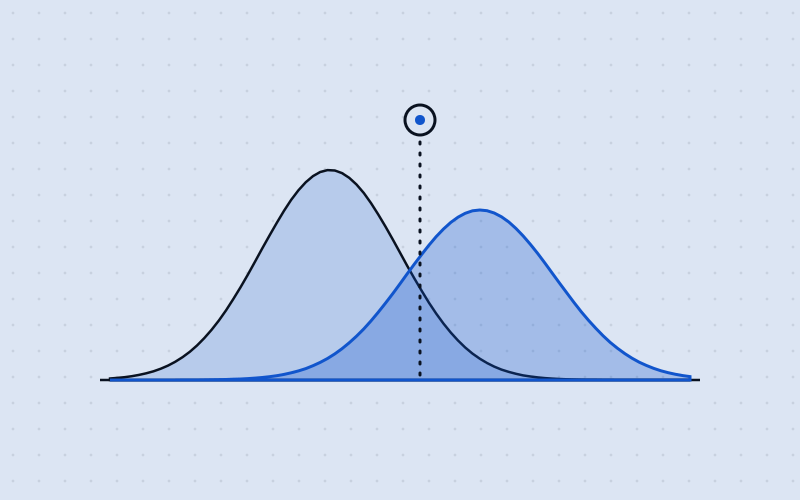
External validation asks a different question: what happens when the system encounters a meaningfully different context?
The distinction matters because medical data contains more than the biological signal a team intends to model. Images may encode scanner, compression, protocol, institution, or positioning patterns. Structured records may reflect local ordering, coding, and documentation behavior. Labels may depend on which tests were available and which patients were referred.
In a well-known cross-hospital study, a pneumonia-detection model showed variable performance across hospital systems and could use institution-specific signals associated with disease prevalence. The lesson is not that every model will fail in the same way. It is that a strong internal result cannot establish transportability on its own.
Define what should transport
Before selecting an external dataset, write down the intended use.
At minimum, define:
- who will use the system,
- which patients, specimens, or cases are in scope,
- what input enters the model,
- what output it produces,
- which decision or review step it supports,
- where and when it will be used,
- what human oversight applies,
- and what happens when the model is wrong or uncertain.
Then identify the conditions expected to vary. For an imaging system, these may include site, scanner, acquisition protocol, view, preparation, or artifact burden. For an electronic-record model, they may include coding patterns, measurement frequency, missingness, clinical pathways, and outcome ascertainment.
The external-validation plan should challenge the transport assumptions that matter to the intended use. A second dataset is not automatically useful merely because it has a different name. If it was assembled from overlapping sources or follows the same acquisition pipeline, it may not provide meaningful independence.
Lock the system before external testing
External validation should begin with a versioned candidate, not a model that changes while the results are being inspected.
Lock and record:
- model architecture and weights,
- input and exclusion rules,
- preprocessing and quality controls,
- feature or label definitions,
- operating threshold,
- abstention or referral logic,
- software and dependency versions,
- and the analysis plan.
The operating threshold is particularly important. A validation set can be used to choose a threshold during development. The external cohort should then estimate performance at that fixed operating point.
If the threshold is adjusted after seeing external outcomes, the exercise has become adaptation or recalibration. That may be appropriate, but it should be reported as a new configuration that needs its own independent evaluation. The original pre-adaptation result should remain visible.
The same rule applies to preprocessing. Changing normalization, exclusion criteria, image selection, or missing-data handling in response to external failures may improve the system, but it changes what is being tested.
Build an independent, source-traceable cohort
A credible external cohort needs more than a sample count.
Teams should document:
- data source and collection period,
- inclusion and exclusion criteria,
- patient or specimen flow,
- outcome definition and timing,
- site and device composition,
- demographic and clinical case mix,
- prevalence of the target condition,
- missingness and technical failures,
- and overlap checks against development data.
Patient-level or case-level deduplication is essential. Public and institutional datasets may contain repeated exams, derived images, transfers, serial specimens, or redistributed source collections. Exact and near-duplicate screening should cross all development and external sources, not only each dataset separately.
Reference labels also need scrutiny. A label derived from a report keyword, billing code, expert panel, pathology result, culture, follow-up event, or adjudicated review does not represent the same evidence. Differences in label quality can make a model look better or worse without reflecting a true change in capability.
Where practical, size the cohort around the intended estimate and uncertainty, not an arbitrary round number. A small cohort with few positive cases can produce unstable sensitivity estimates even when the total sample count looks substantial.
Report more than one aggregate score
External validation should use the measures that correspond to the intended decision.
For a binary classifier, this may include:
- sensitivity and specificity at the locked threshold,
- positive and negative predictive values in the observed prevalence,
- confusion counts,
- ROC and precision-recall behavior,
- calibration,
- confidence intervals,
- abstention or non-evaluable rates,
- and technical failure counts.
Aggregate performance can hide where transport breaks. Report results across relevant sources such as site, device, protocol, demographic group, disease severity, and acquisition period when sample sizes permit.
Subgroup analysis needs restraint. Very small groups produce noisy estimates, and testing many subgroups can create misleading apparent differences. Pre-specify the most important comparisons, show denominators and uncertainty, and treat exploratory findings as signals for further study rather than final conclusions.
Calibration deserves separate attention. A model may preserve useful ranking while its predicted probabilities no longer match observed risk. Prevalence shift, case-mix change, and measurement differences can all affect probability reliability. Recalibration may help in some settings, but it does not repair every form of dataset shift.
Review failures, not only averages
A useful external study explains how the system fails.
Review false negatives, false positives, abstentions, and technically inadequate inputs with qualified experts. Look for patterns such as:
- acquisition artifacts,
- unfamiliar devices or protocols,
- severe or subtle presentations,
- comorbid conditions,
- unusual anatomy or specimen preparation,
- missing context,
- and source-specific shortcuts.
This is also where teams may discover that the input pipeline, rather than the model, is the main problem. A scanner export may invert orientation. A field may be populated differently. A preprocessing service may reject valid cases. A workflow may send cases outside the intended population.
Preserve these failures as evidence. A model card that reports only the strongest cohort and best metric is less useful than a versioned record of where performance changed, why the team thinks it changed, and what action followed.
Separate technical, clinical, and workflow validation
External retrospective validation is important, but it does not answer every deployment question.
A model can perform well on retrospective data while creating friction, alert fatigue, automation bias, or unsafe workarounds in live use. The DECIDE-AI guideline emphasizes early-stage clinical evaluation of actual performance, safety, human factors, and workflow effects before larger trials.
It helps to separate three evidence layers:
- Technical validation: Does the locked system process representative inputs and produce reliable outputs under the target infrastructure?
- Clinical-performance validation: Does it achieve the required performance for the intended population and decision at a fixed threshold?
- Workflow evaluation: Can intended users interpret, review, override, and act on the output safely and effectively in practice?
The required evidence depends on risk and intended use. A research cohort-discovery tool, an educational aid, and a system influencing patient-care decisions do not share the same validation burden.
Use external validation to make a decision
The result of external validation should not be reduced to pass or fail without context.
A useful decision may be:
- Proceed: performance and workflow evidence support the bounded intended use.
- Narrow: use is supportable only for certain sites, devices, populations, or case types.
- Recalibrate: ranking remains useful, but probability or threshold behavior needs local adjustment and fresh evaluation.
- Retrain: important source variation is missing from development data.
- Redesign the workflow: the model is technically adequate, but review, escalation, or data handling is not.
- Stop: the system does not create reliable value or presents unacceptable risk under the target conditions.
One favorable external cohort should not become a claim of universal generalizability. Conversely, one poor cohort should trigger investigation before the team assumes the model itself is irredeemable.
A practical external-validation checklist
Before broader rollout, confirm that the team has:
- A written intended use, target population, user, and decision
- A locked model, preprocessing pipeline, and threshold
- An independent cohort that challenges meaningful transport assumptions
- Patient, specimen, and source overlap checks
- Clear reference-label provenance
- Pre-specified metrics and subgroup analyses
- Confidence intervals and non-evaluable-case reporting
- Site, device, population, and time-period breakdowns where relevant
- Expert review of errors and technical failures
- A documented proceed, narrow, recalibrate, retrain, redesign, or stop decision
- A plan for live workflow evaluation when the system affects real decisions
- Monitoring triggers for future changes in data, devices, sites, or practice
External validation is most useful when it makes uncertainty visible. The goal is not to prove that a model works everywhere. It is to build an honest evidence boundary around where the current system can be used, what remains unknown, and what should happen next.
If your team is preparing a medical-AI model for evaluation across sites or populations, ModAstera can help design the validation cohort, evidence path, review workflow, and deployment controls needed for a bounded decision.
References
- Collins GS, et al. TRIPOD+AI statement: updated guidance for reporting clinical prediction models that use regression or machine learning methods. BMJ. 2024;385:e078378.
- Vasey B, et al. Reporting guideline for the early-stage clinical evaluation of decision support systems driven by artificial intelligence: DECIDE-AI. Nature Medicine. 2022;28:924-933.
- Zech JR, et al. Variable generalization performance of a deep learning model to detect pneumonia in chest radiographs: a cross-sectional study. PLOS Medicine. 2018;15(11):e1002683.
- U.S. Food and Drug Administration, Health Canada, and Medicines and Healthcare products Regulatory Agency. Good Machine Learning Practice for Medical Device Development: Guiding Principles. 2021.
- World Health Organization. Ethics and governance of artificial intelligence for health. 2021.
- National Institute of Standards and Technology. AI Risk Management Framework. 2023.