A medical AI model reports 94% accuracy. Is that good?
Not enough information.
The same number could describe a useful model, a model that misses most clinically important cases, or a model that predicts the majority class almost every time. It does not tell us how errors are distributed, whether predicted probabilities are trustworthy, how performance changes across sites, or whether the output improves the real workflow.
Medical AI evaluation should therefore begin with the decision the model is meant to support, not with a favorite metric. The right evidence depends on intended use, population, operating threshold, human role, and the consequences of false negatives, false positives, delayed review, and uncertain outputs.
Accuracy can hide the error that matters
Accuracy is the fraction of evaluated examples classified correctly. It is intuitive, but it combines different errors into one average.
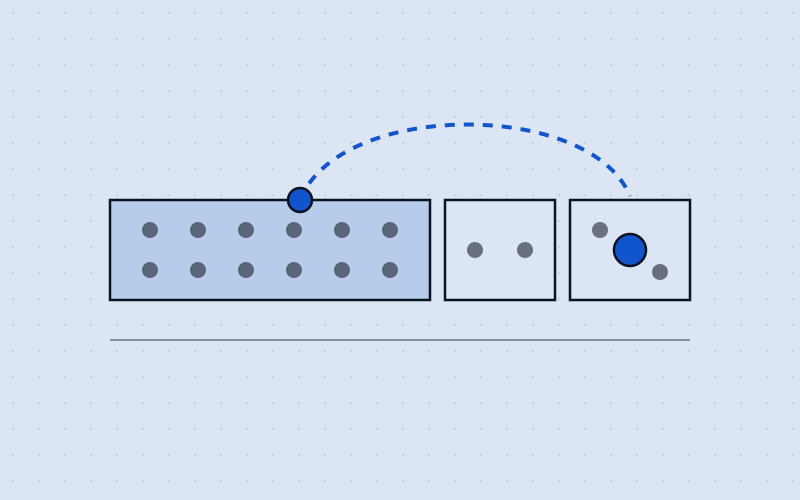
Imagine a dataset where 95 of every 100 examples are negative. A model that predicts every example as negative reaches 95% accuracy while detecting none of the positive cases. The arithmetic is correct. The conclusion that the model is useful would not be.
Even in a balanced dataset, the same accuracy can arise from very different error patterns. One model may miss positive cases. Another may flag too many negative cases. Those failures can have different safety, workload, cost, and user-trust consequences.
This is why a credible evaluation should show the confusion matrix at a stated operating threshold and report the errors separately.
Start with intended use and the supported decision
Before selecting metrics, define:
- who uses the output,
- which population and setting are in scope,
- what the model predicts,
- when the prediction is produced,
- which action may follow,
- what happens when confidence is low,
- and which errors are most consequential.
A triage system that prioritizes cases for review has a different objective from a confirmatory classifier. A quality-control model that rejects poor inputs has a different objective from a risk score. A model that proposes a region for expert review should not be evaluated as though it makes an autonomous diagnosis.
This intended-use framing is central to validation-first medical AI. Metrics become meaningful only when they are connected to the action, user, and failure boundary they are supposed to support.
Build the confusion matrix at a stated threshold
For a binary classification task, the confusion matrix separates four outcomes:
- True positives: positive cases correctly identified.
- False negatives: positive cases missed.
- True negatives: negative cases correctly identified.
- False positives: negative cases incorrectly flagged.
Several familiar metrics follow from these counts.
Sensitivity, also called recall for the positive class, asks: among positive cases, how many did the model identify?
Specificity asks: among negative cases, how many did the model correctly leave negative?
Precision, often equivalent to positive predictive value in a defined evaluation population, asks: among positive predictions, how many were actually positive?
Negative predictive value asks: among negative predictions, how many were actually negative?
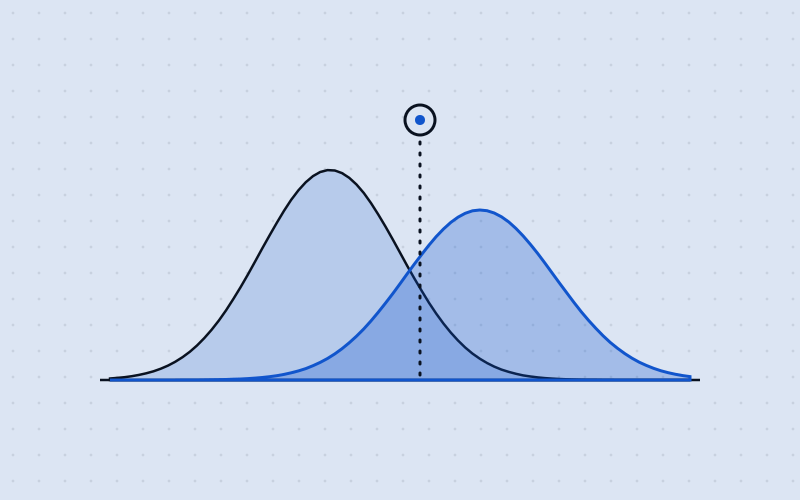
These metrics answer different questions. Increasing sensitivity by lowering a threshold often increases false positives and reduces specificity. Raising the threshold may reduce review burden but increase missed positives. There is no universally correct tradeoff. The acceptable balance depends on the intended workflow and the available fallback or human-review process.
Always report the threshold used. Sensitivity or specificity without the operating threshold and evaluated population is incomplete evidence.
Separate discrimination from operating performance
Discrimination describes how well a model ranks examples, placing positives above negatives across possible thresholds.
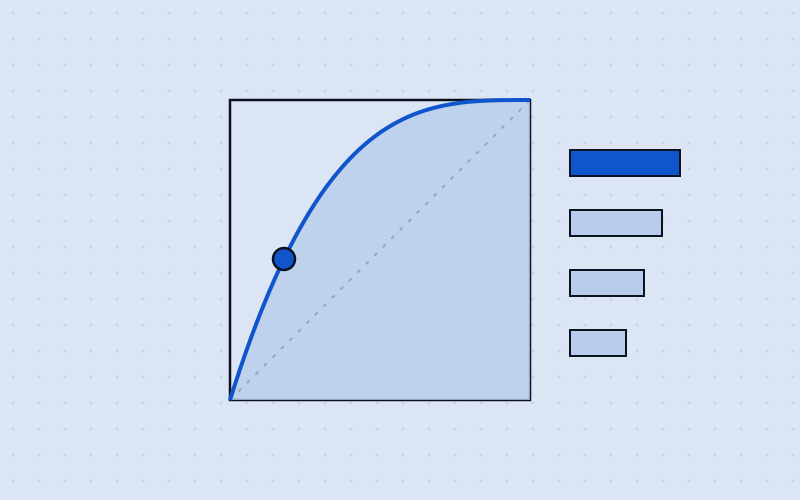
The area under the receiver operating characteristic curve, or AUROC, is a common discrimination measure. It is useful for comparing ranking behavior, but it does not tell a team which threshold to deploy. Two models with similar AUROC can behave differently at the high-sensitivity or high-specificity region that matters operationally.
AUROC can also look reassuring when the positive class is rare and the practical concern is the number of false alerts among positive predictions. Precision-recall curves can make that burden more visible because precision responds directly to false positives and class prevalence.
Neither curve replaces threshold-specific reporting. A review package should include the part of the curve relevant to intended use, the selected operating point, and the confusion-matrix counts behind the headline rates.
Check calibration before treating scores as probabilities
A model can rank cases well and still produce unreliable probability estimates.
Calibration asks whether predicted risks match observed frequencies. Among cases assigned a predicted probability near 0.8, approximately 80% should have the outcome in a well-calibrated model for that population and context.
A poorly calibrated score can create false confidence even when AUROC is strong. This matters when probability influences escalation, scheduling, consent discussions, resource allocation, or a decision to abstain.
Useful calibration evidence may include:
- a calibration plot,
- observed versus predicted event rates,
- calibration intercept and slope,
- a proper scoring rule such as the Brier score,
- and calibration by relevant site, subgroup, or time period.
Calibration should be assessed on data not used to fit the calibration transformation. It can also deteriorate after deployment as prevalence, acquisition, or workflow changes. Model monitoring should therefore track both input conditions and outcome-linked performance where labels become available.
Account for prevalence and case mix
Sensitivity and specificity are properties of performance in an evaluated population, but predictive values depend strongly on prevalence.
If a condition is rare, even a model with high sensitivity and specificity can generate more false-positive than true-positive alerts. If a test dataset artificially balances classes, its precision and negative predictive value may not describe routine use.
Teams should report the evaluation prevalence and explain whether it reflects the intended deployment population. When a curated challenge set changes class balance to expose failure modes, that is useful, but predictive values from that set should not be presented as ordinary operational yield.
Case mix also matters beyond a single prevalence number. Severity, referral patterns, inclusion criteria, missingness, device type, image quality, and site workflow can all change observed performance. The population definition belongs next to the metric, not in an appendix nobody reads.
Choose thresholds on validation data
A threshold is a model-development decision.
It may be chosen to meet a minimum sensitivity, cap false-positive workload, optimize a stated utility function, or define an abstention region. Whatever the rule, it should be selected using training and validation evidence, not by searching the final test set for the most attractive result.
The final test set should estimate performance after the model, preprocessing, calibration method, threshold, and evaluation plan are stable. If test results drive another round of threshold tuning, the set has become part of development and the strength of the final claim should be reconsidered.
Preserve:
- the model and dataset versions,
- the threshold-selection rule,
- the validation result used to choose it,
- the final locked threshold,
- the test-set access history,
- and any post-test changes.
That record connects performance claims to AI traceability instead of leaving the chosen operating point as an unexplained constant in code.
Evaluate subgroups, sites, devices, quality, and time
An aggregate result can hide concentrated failure.
Depending on intended use and lawful data availability, evaluate performance across relevant contexts such as:
- site or institution,
- device, scanner, assay, or acquisition protocol,
- demographic or clinical subgroup,
- disease subtype or severity,
- image or record quality,
- operator or workflow source,
- and time period.
The purpose is not to produce dozens of unstable slices and declare differences from noise. It is to test known risks and deployment conditions. Report the sample size and uncertainty for each slice. Small groups may support a risk signal or further-data requirement rather than a definitive comparison.
External evaluation at another site can strengthen evidence, but it does not establish universal generalizability. Claims should remain bounded by the populations, settings, and systems actually studied.
Quantify uncertainty and inspect individual errors
Point estimates alone can create false precision.
Confidence intervals help show how much a metric could vary because of finite sample size. They are especially important for sensitivity when there are few positive cases, for subgroup analyses, and when several records come from the same patient or case.
The method should respect the sampling structure. Treating many correlated images from one patient as independent can make uncertainty look smaller than it is. Patient- or case-level resampling may be more appropriate when those are the independent units.
Error review is equally important. Examine false negatives, false positives, high-confidence mistakes, and abstained cases. Look for repeated patterns involving artifacts, missing data, labels, acquisition conditions, or workflow shortcuts. A metric tells the team that a failure exists. Case review helps explain why.
Measure the human and workflow system
A clinically adjacent product is usually more than a model endpoint.
If a human reviews, confirms, overrides, or escalates predictions, evaluation should include that system. Relevant measures may include:
- review time,
- alert or case volume,
- override and escalation rates,
- inter-reviewer agreement,
- missed-case detection,
- user comprehension,
- fallback behavior,
- and the effect on the intended operational outcome.
A threshold that looks optimal offline may overload reviewers. A model that improves case ranking may still fail if users cannot understand uncertainty or if integration delays make the prediction irrelevant. Conversely, a model with modest standalone performance may provide value inside a carefully designed human-review workflow.
Model metrics, human factors, and workflow outcomes should be reported separately. One should not be used to imply another without evidence.
A minimum evaluation checklist
Before accepting a medical AI result, confirm:
- Intended use, user, population, setting, and action are explicit.
- The consequences of false negatives, false positives, and abstention are described.
- The confusion matrix and operating threshold are reported.
- Sensitivity, specificity, precision, and negative predictive value are interpreted for the evaluated population.
- Discrimination and threshold-specific performance are not conflated.
- Calibration is checked before scores are treated as probabilities.
- Evaluation prevalence and case mix are visible.
- Threshold and calibration decisions were made before final testing.
- Site, device, subgroup, quality, and temporal risks are evaluated where relevant.
- Confidence intervals reflect the true unit of independence.
- Errors and high-confidence failures are reviewed directly.
- Human and workflow outcomes are measured when the product depends on them.
- Dataset, code, model, threshold, and test-access history are preserved.
- Claims are limited to the evidence actually collected.
Better evaluation supports better decisions
Medical AI evaluation is not a contest to find the most impressive number. It is a structured argument that the model can support a defined decision under defined conditions, with understood errors and uncertainty.
Accuracy can be part of that argument, but it cannot carry it alone. Stronger evidence connects threshold-specific errors, discrimination, calibration, prevalence, subgroups, uncertainty, and workflow outcomes to the intended use. It also preserves enough lineage for another reviewer to understand how the result was produced.
If your team is preparing a medical AI benchmark or validation package, ModAstera can help review metric selection, threshold evidence, and traceability before a headline score hardens into a product claim.